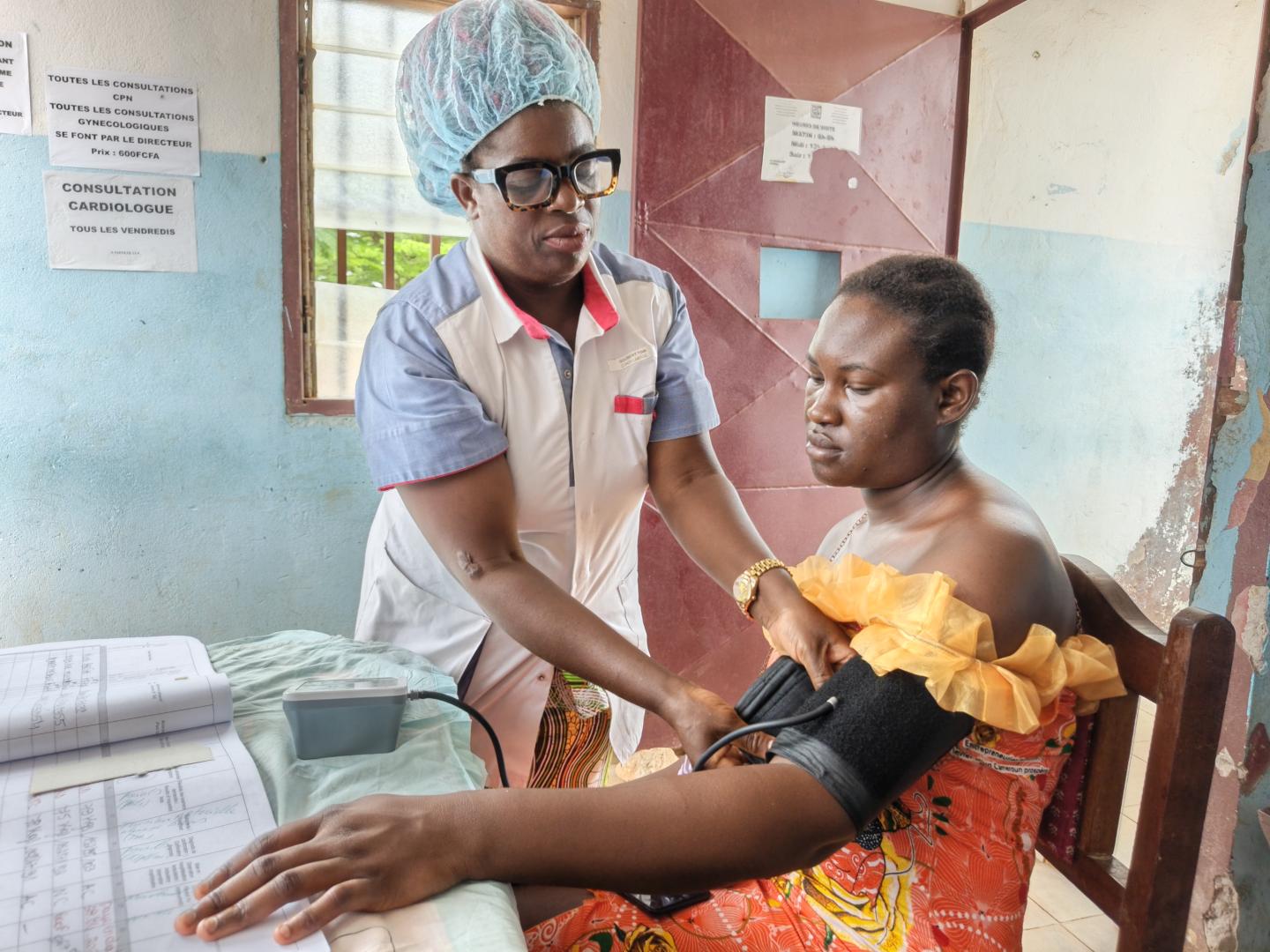
Specialized services for severe chronic diseases now closer to communities in Cameroon
Mfou – To bring specialized care closer to communities and reduce long travel distances for people with severe noncommunicable diseases, Cameroon is gradually implementing the PEN-Plus approach to care, with technical support from WHO and its partners.
This strategy aims to strengthen the capacity of district hospitals in rural and peri-urban areas, enabling them to provide local care to people with severe noncommunicable diseases (NCDs) such as sickle cell disease, type 1 diabetes, severe asthma, or certain heart conditions, which until now have been treated only in specialized hospitals in urban areas. In the Central Region of the country, in Mfou, the implementation of PEN-Plus is already changing the daily lives of many patients, including 17-year-old Jeanine, who has had sickle cell disease since birth. Now that she receives regular care at the PEN-Plus Clinic at Mfou District Hospital, near her home, she no longer has to wait for an attack before seeking help. “I would be in the middle of a sickle cell crisis but have only FCFA 1200 on me to pay for my treatment,” she recalls. “Before, I used to stay home a lot, and every now and then I’d go to the hospital just to get painkillers.”
Sickle cell disease is a genetic blood disorder that can cause severe pain, recurrent infections, and life-threatening complications if not managed regularly. In Cameroon, about 300 000 people live with sickle cell disease and nearly 20 000 with type 1 diabetes, both severe noncommunicable diseases requiring ongoing care. More broadly, noncommunicable diseases account for approximately 35% of deaths in the country (according to the 2022 report by the NCD Task Force in Cameroon).
For many years, people had to travel to regional hospitals to receive specialized care, forcing many families, especially in rural areas to travel as far as 200 km to reach a referral hospital. Beyond the distance, these trips involved significant expenses related to transportation, lodging, and lost income, placing an often-unsustainable financial burden on households. These constraints frequently led to delays in seeking care or even interruptions in treatment, with serious consequences for patients’ health.
Faced with these challenges, the country has begun implementing the first phase of the universal health coverage (UHC) initiative to ensure that quality, equitable, and accessible health care is available to all. However, severe NCDs are not yet included in the UHC health-care package. With support from The Leona M. and Harry B. Hemsley Charitable Trust, WHO, in collaboration with partners, is currently implementing the pilot phase of the PEN-Plus approach in the Mfou and Djoum Health Districts. This approach aims to enhance the skills of health-care teams, promote the use of standardized clinical protocols, and provide ongoing clinical mentoring so that high-quality specialized care can be delivered as close as possible to communities, while reducing the direct and indirect costs borne by families.
Until recently, in Mfou as in other health districts, the lack of specialized services led to frequent referrals to tertiary hospitals. Patients unable to travel to these facilities often received inadequate care for complex conditions. For Jeanine and her family, the financial aspect was a major obstacle. “Cost and lack of resources were our biggest challenges,” she points out.
A turning point came on 17 December 2025, with the launch of the PEN-Plus Clinic at Mfou District Hospital, as well as another clinic opened at Djoum District Hospital in the South Region. Together, these two pilot sites serve a population of approximately 155 000 people. It is now possible to provide local, continuous, and safe care for conditions that previously required referral to distant facilities. The impact on patients has been immediate. “Today, there is someone dedicated to welcoming and following up with them. The reception has really made a difference,” says Jeanine.
This progress also relies on strengthening the skills of health-care staff. In Mfou, two doctors, six nurses, and two laboratory technicians were trained, with support from WHO and partners, in managing sickle cell disease, type 1 diabetes, severe asthma, and certain chronic heart conditions. Ms Amogo, a head nurse and head of the nursing department, explains that these training sessions have transformed the teams’ daily practice: “The training has made us more confident, comfortable and responsive when welcoming and caring for patients.”
She cites the recent case of a 32-year-old woman admitted with severe fatigue and breathing difficulties. An on-site examination identified an emergency requiring immediate attention. “By following the PEN-Plus protocol, we were able to stabilize the patient in just three hours. In the past, she would have been transferred to a specialized hospital,” she explains.
Since the launch of the PEN-Plus clinics in Mfou and Djoum, initial results have been encouraging. In just a few months, 55 specialized consultations have been conducted, and four critically ill patients have been treated locally and stabilized without the need for transfer to tertiary care hospitals.
At the national level, this initiative aligns with Cameroon’s strategy to improve access to quality care for severe chronic diseases, particularly among children and adolescents in rural areas, while strengthening primary health care. “The goal is to make this care accessible and of high quality by building the capacity of district hospitals,” says Dr Emah Manda Yannick, Deputy Director in charge of prevention and control of noncommunicable diseases at the Ministry of Health.
With technical support from WHO and partners, the Government plans to expand the PEN-Plus approach to approximately 30% of the country’s health districts by 2030, with the goal of reducing premature mortality from severe noncommunicable diseases by at least 25%.
For Jeanine, these strategic priorities are already leading to tangible changes in her daily life. “My hope is to stop having these recurring episodes. Even though I still have to pay for some of my medical care, I can now get treatment close to home,” she says.
Communications Officer
WHO Regional Office for Africa
Email: dialloka [at] who.int (dialloka[at]who[dot]int)
Chargée de communication
OMS Cameroun
E-mail: wegangg [at] who.int (wegangg[at]who[dot]int)
Technical Officer (Communications)
WHO Regional Office for Africa
Email: mtabi [at] who.int (mtabi[at]who[dot]int)